
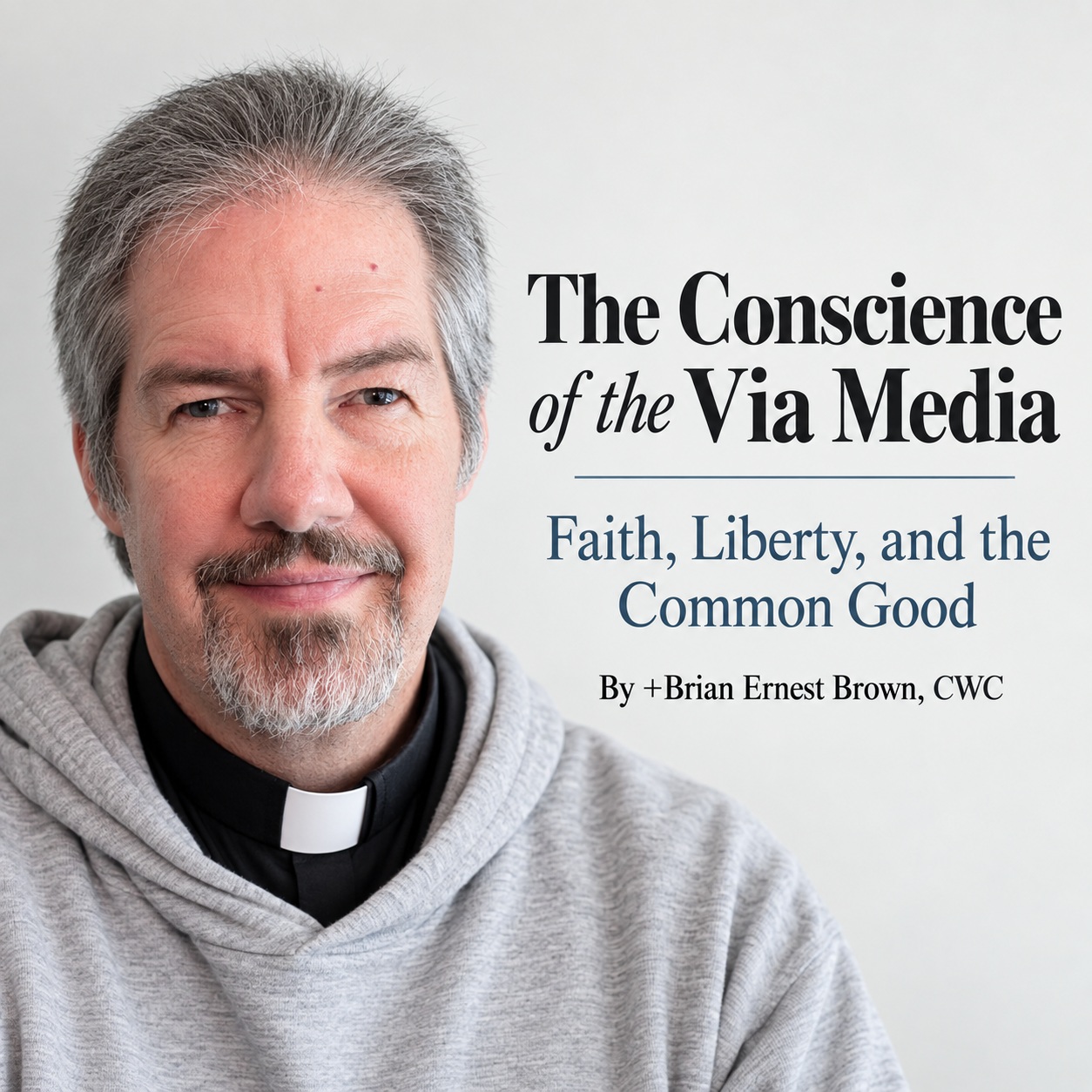
The Conscience of the Via Media: Faith, Liberty, and the Common Good
By +Brian Ernest Brown, CWC
I’ve often found myself too conservative for my progressive friends and too liberal for my conservative friends. I understand why. I believe in universal medical care, free education, fair wages, and our duty to care for the least, the lost, the wounded, the hurting, and the aged. I also believe in liberty, freedom of conscience, public safety, and the value of stable institutions. I’m a Christian pacifist who believes that our communities need protection. I want meaningful reform, and I want us to undertake it carefully enough that the people we’re trying to help aren’t left standing in the wreckage.
For years, I’ve thought of myself as a Christian Socialist. More recently, I’ve come to recognize that Christian Social Democrat may describe my political convictions more precisely. The first speaks to the moral vision that moves me; the second speaks to how I believe we can responsibly put that vision into practice. But before either of those names, I belong to Christ. My concern begins with God and my neighbor, and whatever political language I use has to remain accountable to that calling.
I believe in the Social Gospel because I don’t know how to separate love of God from the circumstances in which God’s children live. Hunger, illness, poverty, loneliness, and exploitation aren’t distractions from spiritual life. They’re places where our faith is tested and where love is called to take flesh. We can speak beautifully about salvation while overlooking the person who can’t afford a prescription or doesn’t know where the next meal is coming from. But sooner or later, the Gospel asks us what we’re going to do.
Christ fed people. He healed people. He welcomed those whom respectable society had pushed aside. His ministry reached into bodies, households, relationships, and communities. Following him asks something of the way we organize our common life, as well as the way we conduct our personal lives.
That’s why I believe everyone should have access to medical care. Illness shouldn’t become a financial catastrophe, and someone’s chance of receiving treatment shouldn’t depend on how much money they have. We can debate how to build and administer a universal system. Those practical questions matter. But the person who needs care must remain at the center of the discussion.
I believe in free, accessible public education for much the same reason. The opportunity to learn shouldn’t be reserved for people whose families can afford it. Education gives people room to discover their abilities, understand the world, and contribute to the life we share. A society benefits when its people are able to develop their gifts. We ought to make that possible without requiring them to spend much of their adult lives paying for the opportunity.
And I believe that every laborer is worthy of their wage. As someone who makes his living with his hands, I know that work carries something of the worker within it. There’s time, skill, patience, and a portion of a human life in what we produce. Honest work deserves fair compensation and decent conditions. When people work faithfully and still can’t meet their basic needs, we have reason to examine the arrangements under which they labor.
I’m comfortable with people earning a living, building a business, and enjoying the fruit of their work. I do those things myself. But economic freedom comes with responsibility. An economy should serve human life, and its success ought to be measured partly by whether ordinary people can live with security and dignity.
Alongside all of this stands something I hold equally dear: the liberty of the spirit.
My Christian faith gives me a reason to support these things. It doesn’t give me the right to demand that everyone else become Christian. My neighbor remains my neighbor whether they share my creed, follow another religion, or profess no religion at all. Their dignity doesn’t depend on their agreement with me.
I cherish the liberal inheritance of freedom of conscience, open inquiry, and the right to live without religious coercion. Faith needs room to breathe. A confession extracted through fear or enforced by law tells us very little about the heart. The Church’s work is to bear witness, invite, serve, and love. We betray that work when we confuse control with conversion.
There’s no contradiction in wanting a society shaped by the demands of neighbor-love while defending everyone’s freedom of belief. We can meet in the public square, offer our reasons, listen to one another, and work toward shared goods without requiring a shared theology. I can advocate for healthcare because I follow Christ. My neighbor can advocate for it for entirely different reasons. We can still build a clinic together.
I also believe that freedom has a practical dimension. Someone facing medical ruin, inadequate education, or wages that won’t cover necessities has fewer real choices than someone who has those needs met. Public provision can give people room to act, create, care for their families, and pursue their calling. At the same time, government must remain accountable. Serving the common good requires us to guard against bureaucracy, abuse, and the concentration of power wherever they occur.
My Christian pacifism belongs within this same understanding of human dignity. I believe the way of Christ calls me toward peace, reconciliation, and the preservation of life. I cannot comfortably bless warfare or treat the suffering of strangers as an acceptable price for national ambition. People beyond our borders are our neighbors, too. Their children are precious. Their grief is real.
Pacifism asks for more than opposition to war. It asks us to practice peace where we are: in our speech, our disagreements, our institutions, and our treatment of people who frighten or anger us. It asks for the courage to confront wrongdoing without surrendering ourselves to hatred.
That brings me to policing and public safety. I’m against abandoning the people who need protection, and I don’t support defunding or abolishing the police. I am open to reimagining and restructuring policing wherever that’s necessary. Supporting an institution doesn’t require accepting everything done in its name.
I want police who understand their work as keeping the peace. I want de-escalation, accountability, respect for civil liberties, and an honest examination of misconduct. I want communities to have mental health care, addiction treatment, and other services that can respond appropriately to needs a police officer may be poorly equipped to address. We ought to ask which response will actually help, rather than reaching for the same response to every crisis.
There are difficult questions here for a pacifist, particularly when protection involves physical restraint or the possibility of force. I don’t pretend those questions disappear because the person exercising authority wears a uniform. They deserve serious moral attention. My commitment is to seek arrangements that prevent harm, reduce violence, and preserve life while keeping people safe and sound.
I approach government reform with similar care. There’s plenty that needs changing. Institutions can become unjust, unresponsive, or more concerned with protecting themselves than serving the people. Respect for stability must never become an excuse for leaving people trapped in suffering.
Still, I distrust the promise that tearing everything down will somehow produce a better world. The vulnerable need care during the transition as well as afterward. The sick still need treatment. The aged still need support. Families still need somewhere safe to sleep. Any plan for change has to answer for those immediate needs.
I favor stable, incremental reform because I want change that people can live through and help shape. That doesn’t mean every reform must be small or every injustice must wait. Some changes are urgent. It means that we should consider the consequences, establish the means to carry out our promises, and protect the people whose lives depend on the systems we’re changing.
I think of this work as tending a garden. Some things need pruning. Some need replacing. Some need room to grow. The soil needs attention, and neglect has consequences. There’s patient work involved, but patience must be active. A gardener who watches everything wither while praising moderation hasn’t done the job.
That’s something of what the via media means to me. It isn’t a requirement to stand halfway between every pair of opposing opinions. I don’t believe there’s a sensible midpoint between caring for our neighbor and abandoning them. The middle way is a discipline of judgment: holding together truths that our political tribes too often pull apart.
Freedom and responsibility belong together. Compassion needs practical expression. Peace requires courage. Stability needs justice if it’s going to endure. Reform needs care if it’s going to accomplish what it promises.
I know that some people will hear these convictions and call me progressive. Others will hear them and call me conservative. I’m more interested in whether I’m being faithful. The names can help us explain ourselves, but they should never relieve us of the responsibility to think, listen, and examine our conscience.
Christian Social Democrat seems a reasonable description of my politics. Christian Socialist still speaks to something in my heart. Christian pacifist names a commitment that reaches through both. And the via media describes the way I try to walk: with firm convictions, an open conscience, and enough humility to know that I may still have something to learn.
My first allegiance remains to Christ and my neighbor. I want a society where people can receive care, learn, work for a fair wage, grow old in dignity, and live safely. I want them to have the freedom to believe, question, and follow their conscience. Those are the convictions I bring to our common life, and the responsibilities I believe love places in our hands.